
How Google Determines Local Rankings — The Three Factors That Actually Move the Needle
Our average client sees 185% revenue growth because we focus on what actually moves Google's ranking needle instead of chasing vanity metrics. While most agencies obsess over keyword density and meta descriptions, Google's local search algorithm operates on three core ranking factors that determine whether your business appears when customers search for your services.
Google calls them proximity, relevance, and prominence. Most agencies optimize for one while ignoring the other two. That's why businesses with great websites still don't show up in the local pack, and why businesses with mediocre websites sometimes outrank them. Understanding how all three work together — and how they interact differently for service area businesses — is what separates a local SEO strategy that generates leads from one that generates reports.
Proximity: Why Location Data Determines Your Search Visibility
Proximity measures how close your business is to the searcher's location. For a brick-and-mortar business this is straightforward — your address is your address, and you can't change how far you are from any given searcher. For service area businesses, proximity is more nuanced and more manageable than most people realize.
The problem most service businesses face isn't their location — it's inconsistent location data. When your business name, address, and phone number appear differently across your GBP, website, social profiles, and directory listings, Google treats those inconsistencies as a verification problem. It can't confidently confirm where your business actually operates, so it hedges by ranking you lower for searches where proximity matters.
This is why citation cleanup comes before citation building. Adding new listings on top of inconsistent existing ones creates more conflicting signals, not fewer. Josh runs every client account personally because he has seen junior account managers build citation campaigns on top of unaudited existing listings and make proximity signals worse instead of better.
Service area businesses face an additional layer of complexity. If you serve customers at their location rather than at a fixed address, you have choices to make in GBP that directly affect how Google interprets your proximity signals. Setting a service area without a listed address tells Google you operate throughout that region. Listing a physical address while also setting service areas tells Google something different. Which configuration is right depends on the business — but it's a decision that needs to be made deliberately, not left at the GBP default.
Location pages are the other proximity lever for service area businesses. A dedicated page for each city or region you serve — with content specific to that area rather than duplicated from other pages — gives Google location signals your GBP alone can't provide. Businesses that serve ten cities but have one generic service page are leaving proximity signals on the table for nine of those markets.
Relevance: How Google Matches Your Business to Customer Searches
Relevance measures how well your business information matches what a customer is searching for. This goes beyond keyword optimization — Google analyzes your business category, services, reviews, and website content to determine whether your business can actually fulfill the searcher's intent.
The highest-leverage relevance decision most businesses never revisit is their primary GBP category. Your primary category is the single strongest signal you send Google about what your business does. It should reflect your most profitable service, not your broadest service offering. "Contractor" is a primary category. "Deck builder" is a better one if that's where your margins are. Get this wrong and you're competing in the wrong category for every search Google shows you for.
The next most common relevance problem is a mismatch between GBP content and website content. If your profile lists pressure washing as your primary service but your website homepage leads with "exterior solutions for every surface," Google can't confidently match you to searches for pressure washing. Consistency between what your profile says and what your website says is a relevance signal. Inconsistency is a penalty.
Review content is the relevance factor that almost nobody optimizes deliberately. Google analyzes the language in your reviews to understand what services you actually provide and how customers describe the outcomes. A detailer with reviews that mention paint correction, ceramic coating, and paint protection film specifically will rank better for those specific searches than a detailer whose reviews only say "great job, highly recommend." The implication is practical: when you ask customers for reviews, giving them a light prompt about the specific service they received produces more relevance signal than a generic ask.
Prominence: Why Authority Signals Control Your Local Search Rankings
Prominence measures your business's overall authority and reputation — how well-known and trusted your business is both online and in the real world. This is the factor that takes the longest to build and the hardest to fake.
Review signals are the most visible component of prominence. Google analyzes review quantity, recency, sentiment, and response patterns. A business accumulating reviews consistently over time demonstrates more legitimate prominence than one that received a burst of reviews in a short window. Recency matters — a profile with strong reviews from two years ago and nothing recent signals an inactive or declining business.
The quality of websites linking to your business impacts prominence more than quantity. One link from your local chamber of commerce, a regional business association, or a respected industry publication carries more weight than links from low-quality directories. Google evaluates the authority and topical relevance of linking domains. This is why real community involvement — sponsoring local events, joining trade associations, getting mentioned in local press — produces SEO value that no link-building package can replicate.
How you respond to reviews is a prominence signal that most businesses underestimate. Google tracks engagement patterns. Businesses that respond consistently to all reviews — positive and negative — demonstrate active management and customer accountability. Businesses that only respond to complaints, or don't respond at all, miss a signal that costs nothing to send. The content of responses matters too — a response that addresses the specific service mentioned in a review reinforces relevance while building prominence.
Josh launched Forget Me Never Media because he watched too many agencies sell prominence tactics — fake reviews, spammy link building, paid directory submissions — that produced short-term ranking movement and long-term penalties. Real prominence comes from real business performance reflected across the web. Google's algorithm has become sophisticated enough to tell the difference.
How All Three Work Together
Proximity, relevance, and prominence don't operate independently. Google combines all three signals for every search, which means a weakness in any one factor can suppress rankings regardless of how strong the other two are.
The most common pattern: a business with strong proximity — good location data, consistent citations — and reasonable prominence, but weak relevance because their GBP categories and website content don't align with the specific searches they want to rank for. They show up for broad searches and disappear for the high-intent specific ones where the real revenue is.
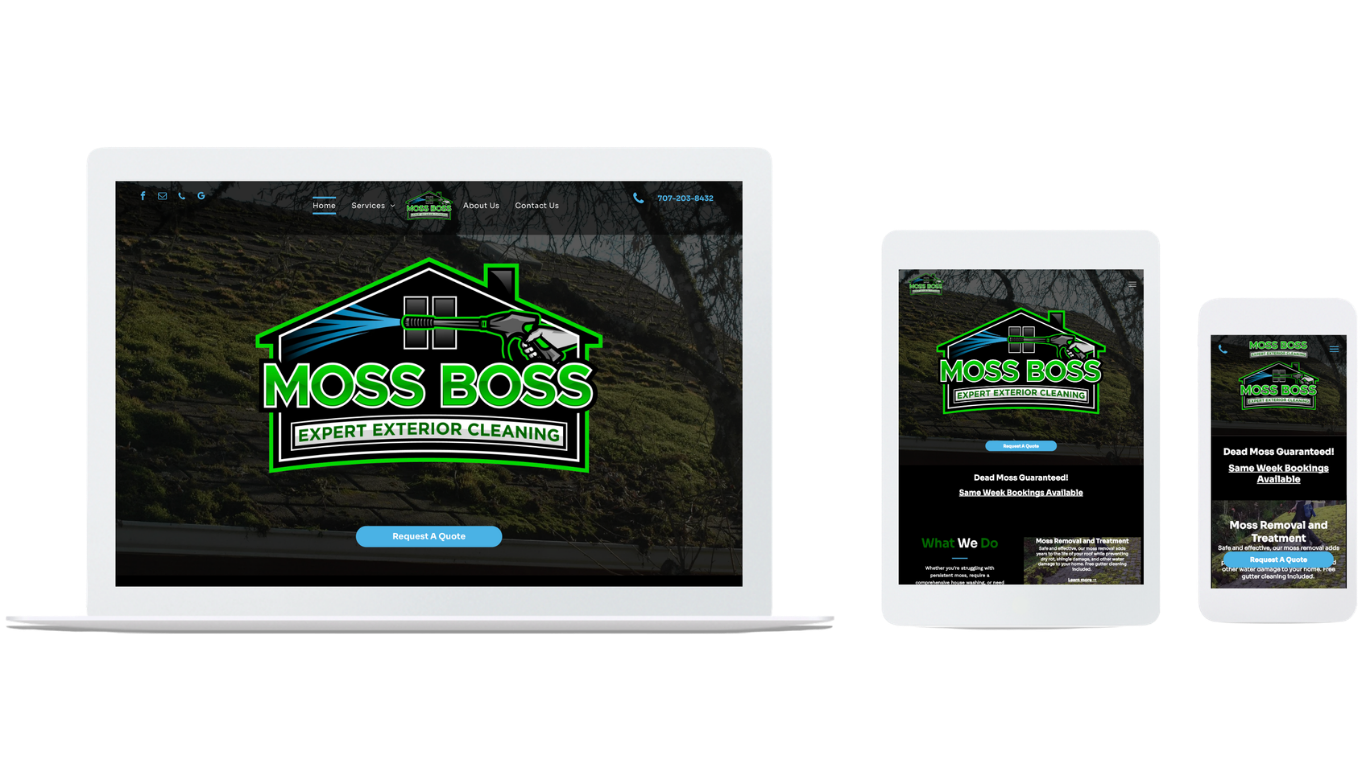
Moss Boss of Humboldt's results — 418% organic traffic increase, 792 leads produced, 180% revenue increase in six months — came from aligning all three factors around their most profitable service searches rather than optimizing for generic pressure washing terms. Proximity signals confirmed their service area. Relevance signals matched their content to the specific searches their ideal customers use. Prominence signals demonstrated authority in the Moss Removal category specifically. All three pointing the same direction is what produced those results.
Most agencies optimize individual tactics. They build citations without fixing relevance. They optimize GBP categories without addressing website content mismatches. They chase reviews without fixing the response pattern that undermines prominence. The three factors only compound when they're treated as a system — which is the only way Josh approaches local SEO for every client account he manages personally.
No long-term contracts. No vanity metrics. Just the three factors that actually determine where your business shows up — and someone who understands how to move all of them.
Table of Contents
IS YOUR BUSINESS READY FOR 2026?
Get a free digital marketing audit and see exactly where your biggest opportunities are hiding.